
A tray icon library over org.kde.StatusNotifierItem, plus
hyprforge-trayd, the daemon that puts network (Wi-Fi and Ethernet),
Bluetooth, keep-awake, night-light, battery/power-profile and
display-layout icons in whatever bar is running, and
hyprforge-traymenu, which draws their right-click menus.
Part of Hyprforge, a suite of native Hyprland desktop apps — but it runs alone. Installing this gets you a tray daemon and the menu it draws, and nothing else.
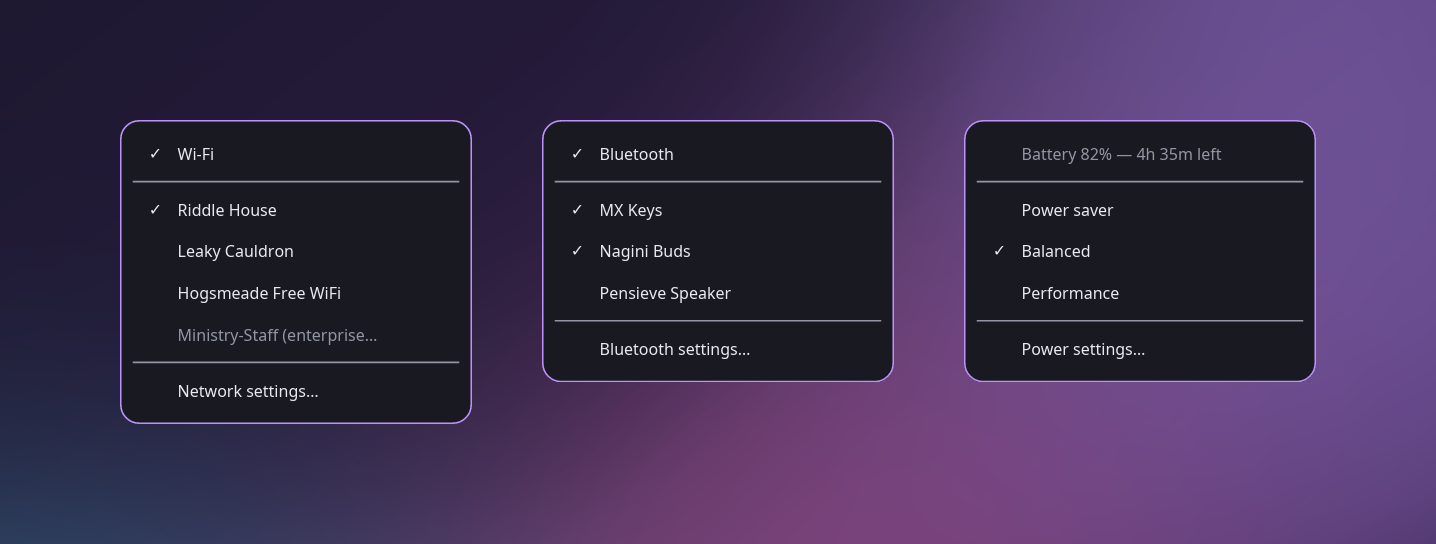
A tray icon is a D-Bus object, not a widget drawn by a toolkit. This
crate registers an org.kde.StatusNotifierItem with whichever
StatusNotifierWatcher a bar runs — the icon a user sees is the bar's
own rendering of a name and a handful of properties read off the bus.
On Hyprland the right-click menu is not left to the bar:
hyprforge-traymenu draws it, themed like the rest of the suite and
anchored below the bar. Where the popup cannot run — another
compositor, or a bar that never asks for it — the daemon serves the
same menu as com.canonical.dbusmenu and the bar draws it instead.
tray.toml's menu = "auto" | "popup" | "dbusmenu" picks; auto, the
default, does the above, and src/lib.rs has the reasoning. That
is what makes it possible inside a suite that forbids GTK and Qt
everywhere else: every other way to put an icon in a tray drags one of
them in.
- The library (
src/item.rs,src/menu.rs,src/sni.rs,src/dbusmenu.rs,src/launch.rs,src/prefs.rs) — the StatusNotifierItem protocol, the menu model, launching the popup that draws it or serving it overcom.canonical.dbusmenu, and which icons the user switched on intray.toml, and nothing else. It knows nothing about Wi-Fi or Bluetooth, the same wayhyprforge-uiknows nothing about Hyprland. hyprforge-trayd(src/bin/trayd.rs) — the daemon that joins the library tohyprforge-network,hyprforge-bluetooth,hyprforge-power(keep awake, oversystemd-logind; battery and power profile, over UPower andpower-profiles-daemon) andhyprforge-ecosystem::sunset_control(night light, overhyprctl hyprsunset) andhyprforge-displayd(display layouts, over its own D-Bus interface, throughhyprforge-core::displayd_proxy), plus the kernel's pressure (pressure: what the machine is waiting on, from/proc/pressure, woken by its triggers rather than polled), and forwards a click tohyprforge-settings --screen <name>— or, for pressure, openshyprforge-procman.hyprforge-traymenu(src/bin/traymenu/) — the popup that draws an item's right-click menu.
NetworkBackend, BluetoothBackend, InhibitBackend,
BatteryBackend, PowerProfilesBackend and SunsetBackend are traits this daemon consumes, each with a mock
behind a mock feature — none of that lives in this crate, it is what
hyprforge-network, hyprforge-bluetooth, hyprforge-power and
hyprforge-ecosystem each expose. What does live here, and is
deliberately structured the same way: which icon a given state
deserves, and which rows a menu needs, are plain functions over plain
data (network_item, bluetooth_item, keep_awake_item,
night_light_item, power_item, displays_item and their *_menu
counterparts in trayd.rs, and
the pure model in src/item.rs / src/menu.rs) — no D-Bus, no bar, no
radio, so the interesting question is testable without any of the
three. Everything else in trayd.rs is plumbing: following the
backends — an icon is refreshed the moment its service signals a change
(watch_signals), with a slow poll for the two that send none, night
light and keep awake — keeping one TrayIcon per item in sync, and
re-announcing when a bar restarts.
A service that is not running is its own state, never an empty
list. hyprforge-tray::sni::TrayError::NoWatcher is what a
StatusNotifierWatcher that has never shown up looks like — the daemon
waits and retries rather than exiting — and trayd.rs's
NightLightState::NotRunning is kept distinct from "night light is
off": hyprsunset confirmed absent is a different fact from a feature the
user switched off, and collapsing the two would mean the wrong action
(start hyprsunset vs. flip a setting) shows up in the menu.
A failed connection is never cached. trayd.rs's Reconnecting
holds a backend connection once one succeeds, and only Ok is ever
stored — a failed connect() leaves nothing behind, so the next poll
tick tries again rather than repeating a stale failure forever. The test
a_failed_connect_is_retried_on_the_next_tick_rather_than_cached pins
exactly this.
cargo build --release
It depends on nine other Hyprforge crates — hyprforge-paths,
hyprforge-network, hyprforge-bluetooth, hyprforge-power,
hyprforge-ecosystem and hyprforge-core (its hyprforge-displayd
D-Bus proxy and bounded subprocess wait) for the daemon, and hyprforge-popup,
hyprforge-appearance and hyprforge-look for the menu — published on crates.io,
so cargo fetches them from there and never needs the main repository. Nothing else here is Hyprforge-specific.
packaging/hyprforge-trayd.service is a user unit:
systemctl --user enable --now hyprforge-trayd
That is the manual route. The Arch package enables it for every user
when it is installed, through a systemd preset. With Hyprforge Settings
installed, its Set up page (or hyprforge-settings --setup) enables
it and can undo that.
Restart=always rather than on-failure: the daemon waits for a
StatusNotifierWatcher rather than exiting when there isn't one yet, so
starting before the bar is not a race it can lose, and a clean exit that
leaves the tray empty is exactly as bad as a crash — it should not read
as a healthy, stopped unit.
.github/workflows/ci.yml builds the crate, runs clippy with warnings
denied, and runs cargo test. That is tier 1 only:
tests/live_tray.rsregisters a real item against whateverStatusNotifierWatcheris running and asserts the watcher lists it — the visible side effect is an icon appearing in a real bar for a fraction of a second. That is the one deliberate exception to this suite's "the live tier is read-only" rule: nothing else here writes configuration, clicks anything, or starts a discovery session, but registering an item is putting something in the user's bar, however briefly, and there is no way to ask "does a real host accept this" without doing exactly that. These tests are#[ignore]d and needcargo test -p hyprforge-tray -- --ignoredon a machine with a bar running.tests/live_icons.rsresolves every icon name this daemon can put on the bus against the icon themes actually installed — it needs no bus or bar, only files on disk, but it does need a real icon theme to be present to mean anything, and marks itself skipped (HYPRFORGE-SKIP:) rather than passing silently when one isn't.- Nothing here exercises
hyprforge-networkagainst a real NetworkManager,hyprforge-bluetoothagainst real BlueZ, orhyprforge-poweragainst real logind — those crates' own live tests cover that, gated on the service each one actually asks.
A green run means the code is internally consistent, not that a real bar shows the icon or that this daemon has ever touched a real radio.
MIT. See LICENSE.