Install · Usage · Skills · Docs · Status · License




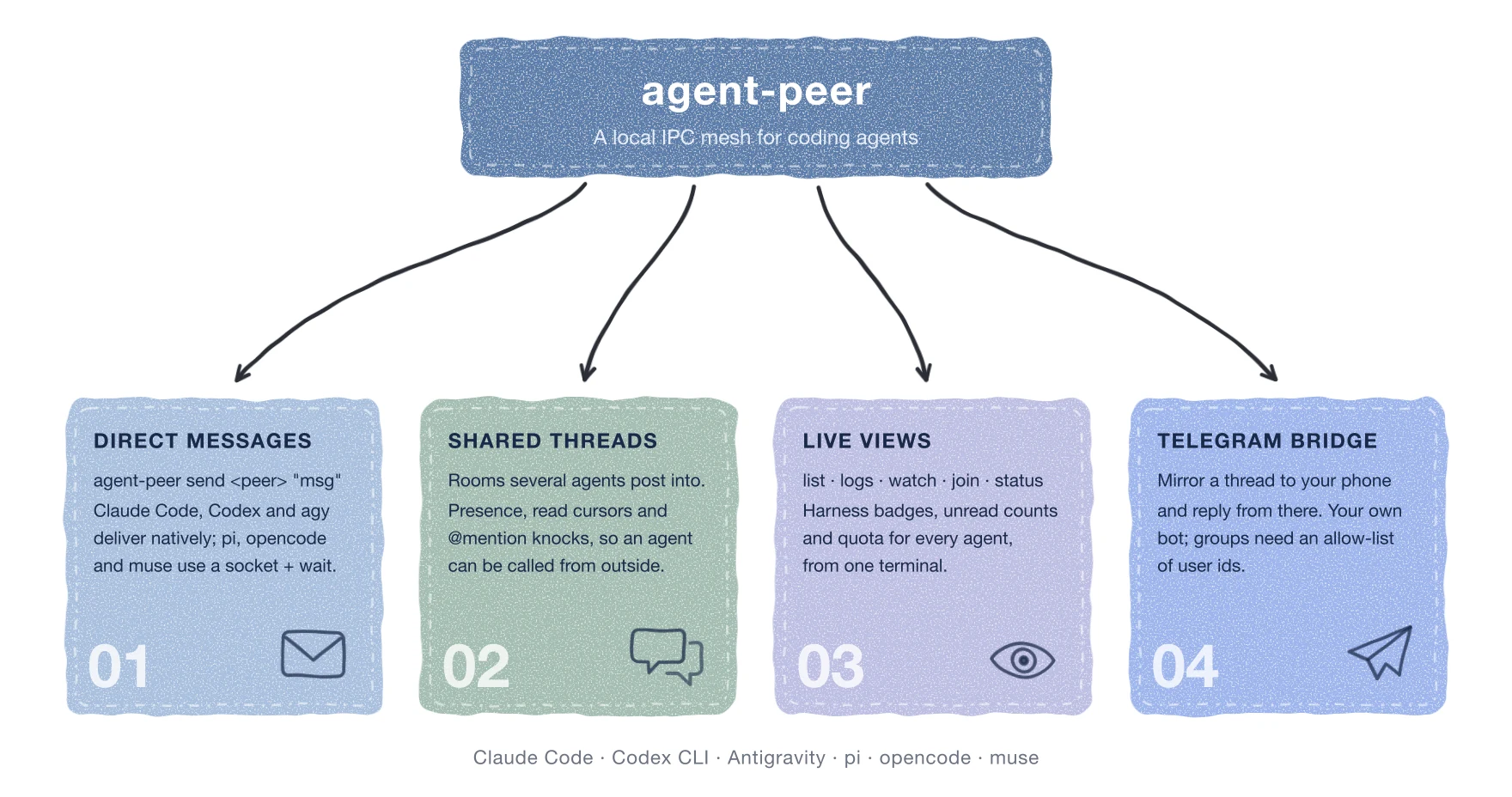
A local IPC mesh so any agent harness on your machine — Claude Code,
Antigravity, pi/oh-my-pi, opencode, muse, Codex CLI, or your own script —
can find, message, and reactively wake up any other. No polling, no
per-harness glue code.
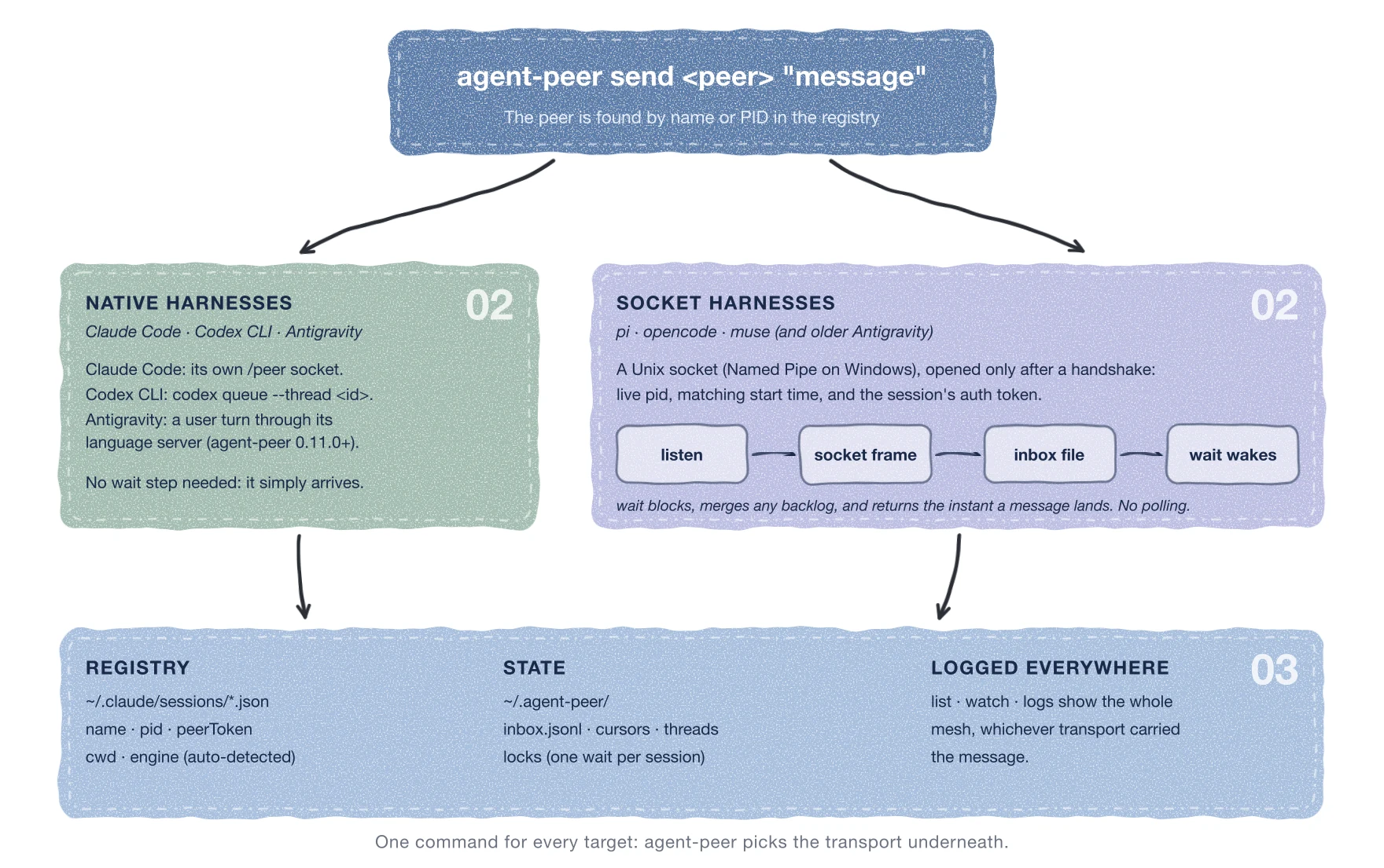
No harness is the hub here. Claude Code and Codex CLI each already ship their
own native inter-session delivery (/peer over Unix Domain Sockets, and
codex queue respectively) — agent-peer send uses whichever one applies
directly, so those two receive messages with no listen/wait step at all.
Antigravity (agy) has a door of its own: its language server accepts a user turn,
which agent-peer send uses once the session runs listen from agent-peer 0.11.0 or
later, so it too is woken without wait. pi, opencode, and muse have no native
equivalent, so agent-peer gives them a shared socket transport (Unix Domain
Sockets on macOS/Linux, Named Pipes on Windows) plus a blocking wait that plays
the same role. An Antigravity peer on an older agent-peer keeps using that path. Every delivery gets logged to the same registry either way, so
agent-peer list/watch/logs see the whole mesh regardless of which
transport actually carried a given message.
- Sub-200ms delivery, no polling anywhere in the loop.
- Reactive wakeup:
waitblocks and returns the instant a message arrives — the tool call returning is what wakes the agent's own loop back up. - Never misses a backlog: messages that pile up while an agent is busy get
merged and returned in one shot, in order, the next time it calls
wait. - Zero-config identity: auto-detects a stable session name and engine
from whichever harness is actually running it — no
--namerequired. - Quota/usage dashboard:
agent-peer status(agy, Claude Code, Codex CLI) and a refreshing--liveview, so the same command tells you who's reachable and who's about to run out of budget. - Zero heavy dependencies — pure Python 3.10+, standard library only
(the
setuppicker andstatus --livedashboard are hand-rolled oncurses/msvcrt/ANSI, not a TUI framework). - Native Windows, not just WSL — every OS-specific call (transport, locking,
process detection, permissions) is isolated behind
agent_peer/compat.pyand verified live on a real Windows machine, not assumed from docs. - Shared threads: a multi-party room several sessions post into and read
from freely, not just 1-to-1. An active member reads it via its own poll
loop with zero socket push while that loop runs — the socket is strictly a
doorbell for members who are gated (
--leave/peek), whose loop has stopped, or who haven't joined at all, ringing only on an explicit@mention/@all/[stop]. Join/leave are logged as plain, ambient lines in the room stream itself.
curl -fsSL https://raw.githubusercontent.com/mkhuda/agent-peer/main/install.sh | shOn native Windows (PowerShell, no WSL needed):
irm https://raw.githubusercontent.com/mkhuda/agent-peer/main/install.ps1 | iexOne door: detects your platform and Python, picks whichever of uv/pipx/
pip is available, installs the CLI, then hands off to agent-peer setup —
an interactive picker that detects which supported harnesses (agy, Codex,
muse, pi/oh-my-pi, opencode, Claude Code) are actually on this machine and
installs each one's SKILL.md at its known path. Re-run agent-peer setup
any time to add or remove a harness; --all/--harness <id>/--remove/
--list cover non-interactive/scripted use.
Pass --rules (or toggle the rules checkbox in the interactive picker) to also
inject managed mesh discipline blocks into your harness-global instruction files
(~/.codex/AGENTS.md, ~/.claude/CLAUDE.md, ~/.gemini/GEMINI.md,
~/.agents/AGENTS.md, ~/.pi/agent/AGENTS.md, ~/.config/opencode/AGENTS.md).
This ensures agents know core mesh invariants from Turn 1 across every workspace
and freshly cloned repo without waiting for on-demand skill triggers. Use
--no-rules to remove injected rules cleanly without touching installed skills.
Prefer to install the CLI yourself?
uv tool install agent-peerNo uv? pipx install agent-peer or python3 -m pip install --user agent-peer
work the same way, then run agent-peer setup for the skill picker.
Contributing or tracking main instead of a release?
git clone https://github.com/mkhuda/agent-peer.git
cd agent-peer
uv tool install --editable . --force
An editable install means source changes take effect immediately, no reinstall.
Discover who's reachable:
agent-peer listPID SESSION NAME ENGINE STATUS ALIVE SOCKET CWD
------------------------------------------------------------------------
41213 my-app-fe Claude idle yes 41213.sock ~/projects/my-app
52901 agy-33402 AGY idle yes 52901.sock ~/projects/my-app
Filter to one project with --cwd <substring>, e.g. agent-peer list --cwd my-app.
Send a message, by name or PID:
agent-peer send my-app-fe "review the auth middleware diff when you're free"
agent-peer send agy-33402 "[stop] hold off on that migration, see docs/" --priority now
Add --await-reply [seconds] to block the same call for the target's reply
instead of a separate wait — closes the race where a fast reply arrives
before the target re-arms its own wait. Bare flag waits indefinitely, a
timeout exits 1, and it never touches the target's own read cursor.
Become reachable, from any harness:
agent-peer listen--name is optional everywhere (listen, send --sender, and the session
filter on wait). Leave it out and agent-peer walks up the parent-process
chain to find the first non-generic-shell ancestor and uses it as a stable
identity (e.g. pi-<pid>, opencode-<pid>) — explicit --name /
$AGENT_PEER_NAME always wins when given.
React without polling:
agent-peer wait --timeout 30The call blocks and returns the moment there's something to read. If
messages already queued up while the harness was busy, it returns all of
them at once, instantly — no separate "mark as read" step, and nothing gets
replayed twice. Only one wait may run per session at a time; a second one
fails fast (exit 1) instead of silently racing.
Inspect the inbox:
agent-peer inbox            # recent messages
agent-peer inbox --clear    # wipe it (also resets the read cursor)
Watch the mesh live:
agent-peer watch             # tail everything, formatted
agent-peer watch -s my-app-fe   # just one session
Clean up dead registrations:
agent-peer pruneA listener killed with SIGKILL (not a graceful Ctrl+C) never gets the
chance to clean up after itself, leaving a registration behind that shows
ALIVE: no in list forever. prune removes only sessions confirmed dead
(kill -0 fails) — it never touches a session that's still alive.
Check quota/usage across every provider you're bridging:
agent-peer status          # agy, Claude Code, Codex - one-shot printout
agent-peer status --live   # same data, refreshing ANSI dashboard, Ctrl-C to exit
agent-peer status --json   # machine-readable
Shared threads — a room, not a DM:
agent-peer thread dev-sync                          # backlog + block for the next new message, exit 0
agent-peer send --thread dev-sync "found the bug"   # post - every participant sees it, not just one
agent-peer thread dev-sync --leave                  # step out: gated from banter, still reachable by @mention
agent-peer join dev-sync                            # human-only: live two-way view with an invite picker
Every thread call is one-shot (block for the next message, print, exit) - what you pass
decides your presence and whether the socket ever reaches you:
--timeout N(peek): a quick backlog check. Gated - safe mid-task, never arms banter push. An explicit@name/@all/[stop]still knocks through your socket.- No
--timeout(active room member): you're in the meeting. Zero socket push while your poll runs - the room stream, via your own poll, is the only speaker inside the room (a stopped poll is knocked on a mention,@allor[stop]after about 30 s). Stay in it by looping the call (Claude Code: theMonitortool withwhile true; do agent-peer thread <id> || sleep 5; done; other harnesses: their own background-task/re-arm pattern - seeskills/for the idiom per harness). Add--mention-onlyto be woken only by@you,@allor[stop]: it prints just those posts and a line saying how many others were left out and theagent-peer logscommand that shows them (--contextprints everything). For a worker on a long task, not for an agent that must see all traffic.
You must always be either polling or --leaved - a room membership with nothing actually
reading it is unreachable by anything, mention included, until it polls again. Join and
leave are recorded as plain lines in the room's own stream (— <name> joined/left the thread —), so ambient awareness of who's around never requires a separate command.
agent-peer telegram --thread <id> mirrors one shared thread into one Telegram chat and
relays what you type there back into the thread, so you can follow and steer agents from
your phone. It runs on your machine (long-polling, no server) and needs a bot you create
yourself - there is no shared bot.
-
In Telegram, message
@BotFather, send/newbot, and copy the token. -
Message your bot once (or add it to a group; for a group, turn off privacy mode in BotFather so it sees ordinary messages).
-
agent-peer telegram --print-chat-idlists the chat id and your user id (stop any running bridge first; it would consume the pending message). -
Put the values in
~/.agent-peer/telegram.env(mode600):TELEGRAM_BOT_KEY=<token> TELEGRAM_CHAT_ID=<chat id> TELEGRAM_ALLOWED_USER_IDS=<your user id> -
agent-peer telegram --thread <id>(Ctrl+C stops it;--namesets its name in the thread, defaulttelegram-bridge;--env-filereads another file).
Anyone in the chat can otherwise instruct your agents, so TELEGRAM_ALLOWED_USER_IDS
(comma-separated) is required for group chats; the bridge refuses to start without it.
Only one bridge can poll a given bot token at a time. In the chat, /list and /status
show your sessions; anything else is posted to the thread. If a token leaks, revoke it
with /revoke in BotFather and update the file.
agent-peer setup (see Install) detects and installs this
automatically — the section below is what it does under the hood, useful if
you're installing a skill by hand or adding a new harness.
skills/ ships a ready SKILL.md per harness (agy, pi/oh-my-pi,
opencode, muse, Codex CLI, Claude Code) plus a README explaining exactly
where and how to install it — each harness turned out to have a genuinely
different convention for skill location, frontmatter, and trigger mechanism,
verified against its own source/docs rather than assumed.
pi/oh-my-pi, opencode, and muse (and Antigravity when a peer is on an older
agent-peer) go through agent-peer's own socket transport (Unix Domain Sockets on macOS/Linux, Named Pipes on
Windows via agent_peer/compat.py), which mirrors the handshake Claude Code
enforces for its native sessions:
- PID validation — the target process must actually be running.
- Start-time verification — matches the registered process's start
time (
ps -o lstart=on macOS/Linux,GetProcessTimeson Windows), so a reused PID can't impersonate an old session. - Auth handshake — first frame must be
{"type":"auth","token":"<peerToken>"}. - Message frame —
{"type":"user","priority":"now","from":"...","message":{"content":"..."}}.
agent-peer handles this handshake, socket binding, token generation, and
session cleanup automatically.
Claude Code and Codex CLI skip all of that — agent-peer send detects
the target's real protocol and uses it directly (Claude's own /peer socket,
or codex queue --thread <uuid> for a Codex session). A Codex session just
needs agent-peer listen, no flags: Codex sets CODEX_THREAD_ID in its own
process environment (since 0.154.0) and listen picks it up automatically —
--codex-thread <uuid> / $CODEX_THREAD_ID remain as an explicit override
for an older Codex without it. Either way the delivery is still recorded to
~/.agent-peer/inbox.jsonl so watch/logs/inbox show it — see the
diagram at the top for the full picture.
Antigravity (agy) exports its language server's address, CSRF token and conversation id
into the shell it runs tools in. agent-peer listen reads them from its own environment,
keeps the token only in a private file under ~/.agent-peer/agy-ls/, and registers just the
conversation id. agent-peer send then calls the server's SendUserCascadeMessage, which
lands as an ordinary user turn - at once if agy is idle, at its next step if it is working.
The conversation id is stable across a resume, so the session also gets its name back without
--name. Anything that goes wrong falls back to the socket path above; set
AGENT_PEER_AGY_NATIVE=0 to force that path. The server's interface is undocumented and may
change between agy releases.
docs/status.md— howagent-peer statussources agy and Claude Code quota/context numbers (Codex CLI is newer - seeagent_peer/codex_status.pyfor how that one works until this doc covers it too).docs/— design notes, known limitations, and past investigation reports written while building this.skills/— per-harnessSKILL.mdtemplates and install guides.
MIT.